
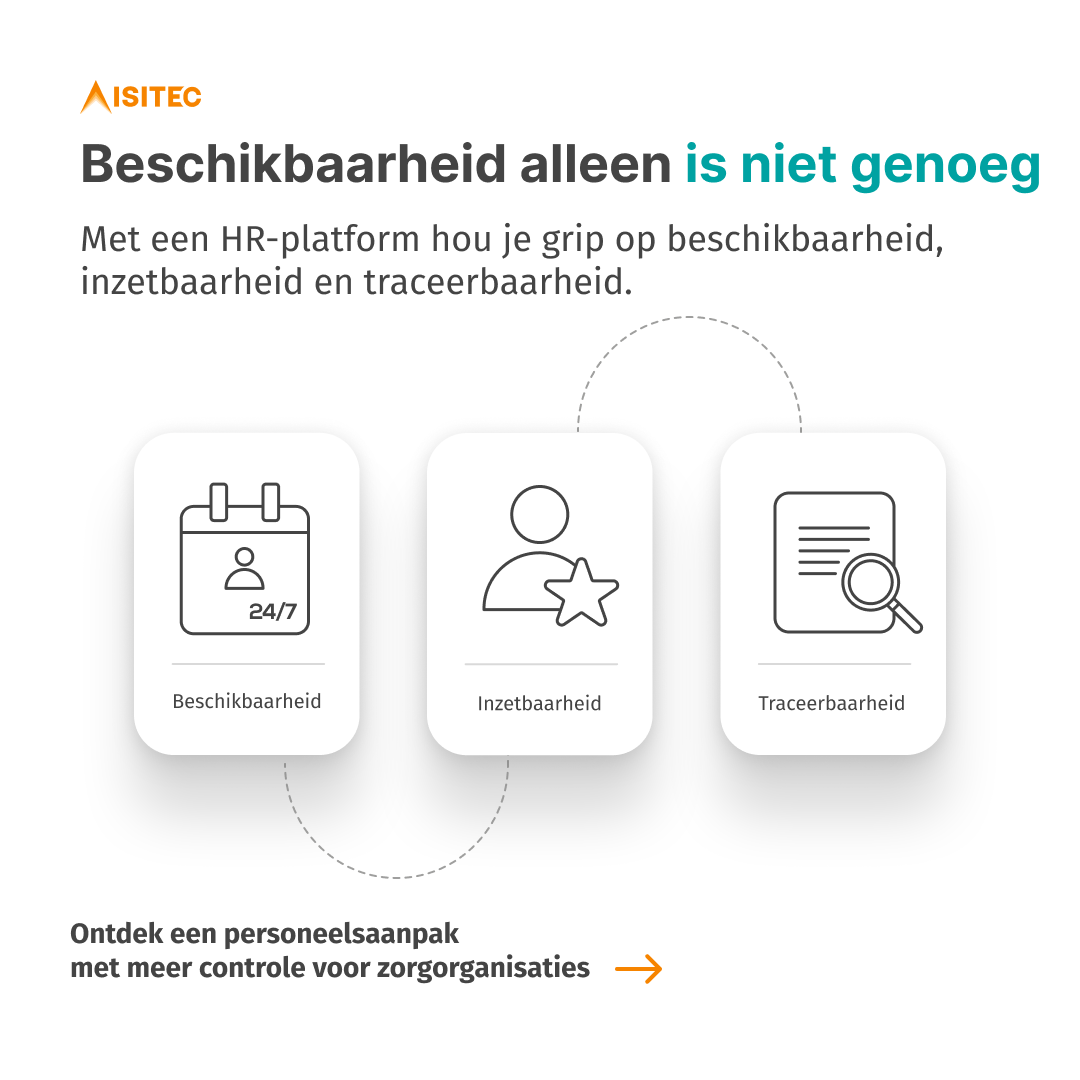
In healthcare, workforce scheduling never operates in isolation.
A change to a shift affects staffing levels, time tracking, absence management and, ultimately, payroll and reporting. When these processes are managed in separate systems, HR must repeatedly monitor the connections between them manually.
That is exactly where the complexity begins.
Not necessarily because one system performs poorly, but because each system only sees part of the reality.
For healthcare organisations working with day, night and weekend shifts, different contract types and unpredictable absences, a standalone scheduling tool is therefore rarely sufficient.
Workforce scheduling must be connected to the rest of the HR workflow.
In healthcare, one absence changes more than one schedule
When an employee unexpectedly reports sick, the schedule must be adjusted quickly.
A replacement is found, the shift is covered and staffing may appear to be resolved.
But that single change triggers several other processes.
The absence must be registered correctly. The replacement employee’s hours must be updated. Any night, weekend or other premiums must be included. Payroll needs reliable data, and management wants to understand what the change means for staffing levels and workforce costs.
When this information is spread across different tools, emails and files, someone must manually monitor the entire chain.
The shift may have been covered, but the process is not yet complete.
Scheduling without HR context remains limited
A schedule shows who is working and when.
But in a healthcare environment, that is only part of the information required.
HR also needs to know the contractual conditions under which someone works, which absence rules apply, how many hours have already been worked and which changes still require approval.
Finance needs accurate data for payroll preparation and workforce reporting.
Management needs visibility into staffing levels, absences and structural shortages.
When this information is spread across different systems, delays occur. The schedule is updated, but the administrative and financial consequences are only processed later.
This does not only increase workload.
It also makes it more difficult to respond quickly and reliably.
Compliance requires connected processes, not isolated checks
In healthcare, compliance is not a separate process that can simply be reviewed afterwards.
It is embedded in daily operations.
Contract conditions, absences, access rights, approvals and reporting must all be managed consistently. When information is stored in different places, it becomes more difficult to determine which version is correct and who is responsible for a change.
A significant amount of control then remains dependent on individual employees who know:
- where information must be updated;
- which approval is still missing;
- which data must be sent to payroll;
- which exceptions require manual follow-up.
As long as this knowledge remains with a small number of people, the process may appear manageable.
But as soon as someone is absent, changes role or the organisation grows, the true vulnerability of the workflow becomes visible.
Compliance becomes stronger when processes are traceable and data flows through one clear and consistent structure.
Reporting must reflect what is happening operationally
Healthcare organisations need reliable information about staffing levels, worked hours, absences and workforce costs.
But when scheduling, time tracking and HR administration are not connected, reporting will always lag behind reality.
Data must first be exported, combined and checked before it can be used.
This creates distance between what is happening on the work floor and what management eventually sees.
A report may be technically correct, but still arrive too late to support meaningful intervention.
In a 24/7 environment, that is a serious limitation.
Management does not only need historical figures. It also needs insight into current patterns:
Where are structural staffing shortages emerging?
Which teams experience the highest levels of absence?
Where is overtime increasing?
Which shifts create recurring problems?
These questions can only be answered reliably when scheduling, HR data and reporting are connected.
The complexity lies in the exceptions
Standard processes are rarely the greatest challenge.
The pressure arises when something deviates from the plan.
An employee becomes unexpectedly unavailable. A replacement only works part of the shift. A contract change must be processed quickly. A team works across several locations. An absence affects both scheduling and payroll.
When situations like these occur every day, basic scheduling is no longer enough.
HR needs a system that can follow changes and automatically transfer the right information to the next stage of the process.
That is where the difference emerges between standalone workforce tools and a connected HR ecosystem.
The role of Aisitec
Aisitec connects workforce scheduling and time tracking with HR administration, absence management, contract workflows, payroll preparation and reporting.
As a result, a change to a shift is not treated as an isolated piece of information, but as part of the complete employee workflow.
The platform can be configured for complex workforce structures and connected to existing payroll, ERP and time-tracking systems.
For healthcare organisations, this means fewer manual transfers, greater data consistency and a clearer view of what operational changes mean for HR, Finance and management.
The value does not lie only in individual features.
It lies in the way the processes are connected.
Healthcare HR requires one connected reality
Accurate scheduling is essential for healthcare organisations.
But scheduling alone does not provide sufficient control.
The real value emerges when shifts, absences, contracts, payroll preparation and reporting all work from the same data structure.
The most important question is therefore not only:
Who is working and when?
But also:
What happens throughout the rest of the organisation when that schedule changes?
When compliance, shifts and reporting operate separately, HR must continue to manage the connections manually.
When they work together, they create an HR environment that better reflects the daily reality of healthcare.
See how connected healthcare HR works in practice
Discover how Aisitec connects scheduling, time tracking, absences, contracts, payroll preparation and reporting within one HR environment.
 English
 Dutch
 French