
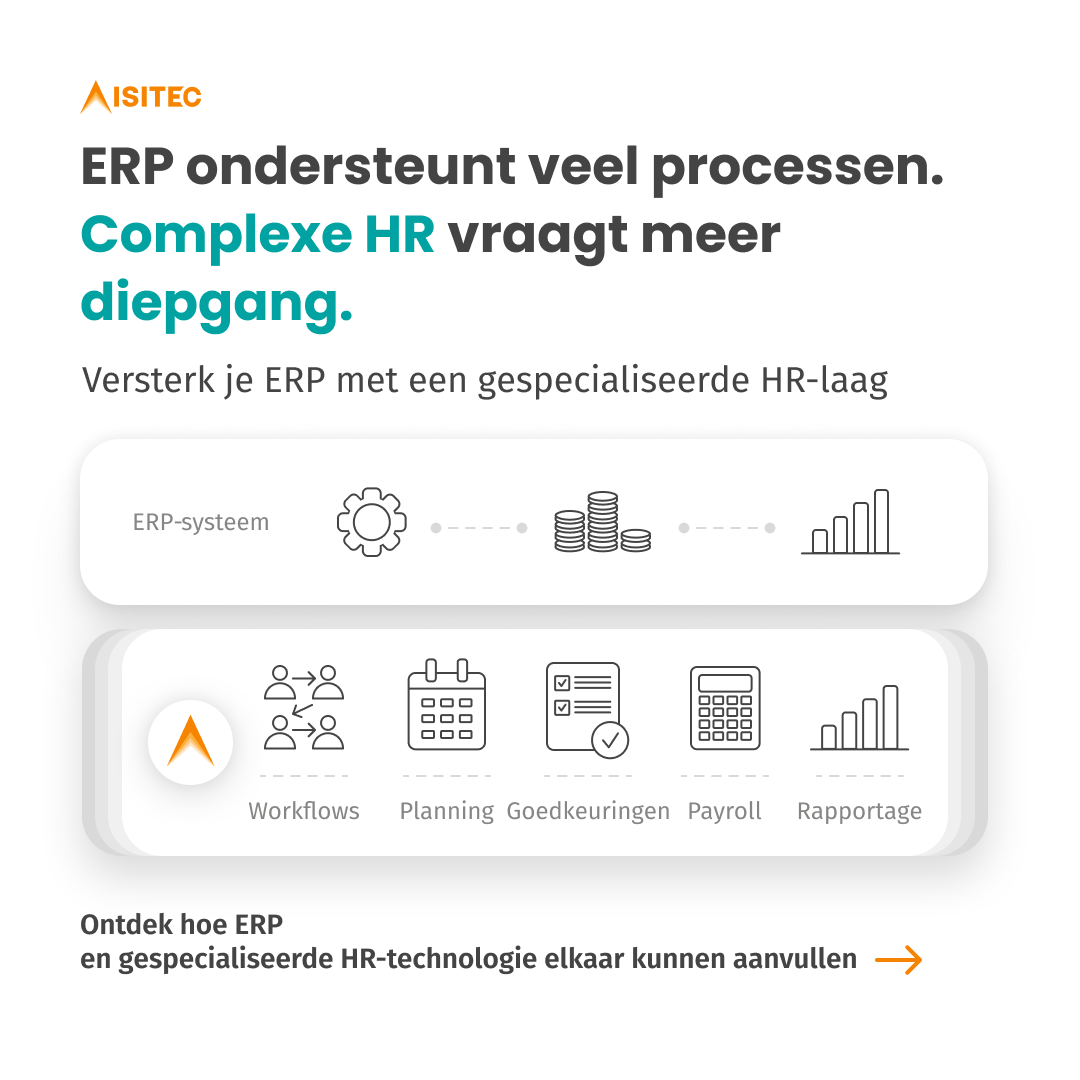
ERP systems form the backbone of many organisations.
They connect Finance, procurement, inventory, sales and other business processes within one central environment. For organisations that need greater structure, control and consistency, an ERP system can therefore provide substantial value.
The problem does not arise because ERP systems are not powerful enough.
It arises when companies expect a general HR module to provide the same depth as a platform specifically designed for complex HR processes.
As long as HR mainly involves basic employee data, simple absences and standard reporting, an ERP module may be sufficient.
But as soon as the workforce reality becomes more complex, the limitations start to become visible.
HR is more than an employee record
In many ERP systems, HR begins with a central employee profile.
This may include personal details, contract information, departments and possibly absences or basic registrations. That provides an important starting point, but it does not represent the complete day-to-day HR operation.
A mid-sized organisation often also needs to manage:
- different contract types;
- day, night and weekend shifts;
- variable working schedules;
- last-minute replacements;
- multiple locations;
- leave and absence workflows;
- approval procedures;
- onboarding and offboarding;
- payroll preparation;
- reporting for HR, Finance and management.
These processes do not operate independently.
A scheduling change may affect time tracking, absences, contract conditions and payroll. A contract adjustment may require a new approval workflow. A new employee creates tasks for HR, IT and the line manager.
When the HR module does not fully support these connections, the complexity shifts back to spreadsheets, emails and manual follow-up.
The complexity lies in the exceptions
A standard process is relatively easy to digitalise.
The real test begins when daily reality deviates from the standard scenario.
An employee becomes unavailable shortly before a night shift. A colleague takes over only part of the hours. A temporary employee works across several locations. A contract change requires approval from several people. Worked hours and premiums must be prepared correctly for payroll.
Each individual scenario may appear manageable.
But when exceptions like these occur every day, basic registration is no longer enough. HR needs workflows that can follow changes and automatically transfer the correct information to the next stage.
That is often where a general HR module stops and a specialised HR platform begins to create value.
Replacing the ERP is not always the solution
When companies encounter the limitations of their HR module, they may assume they are facing a radical choice.
Either they continue working within the limits of the ERP system.
Or they replace a substantial part of their existing environment.
That distinction is not necessarily valid.
An ERP system can retain its central role in Finance, inventory, procurement and other core business processes. At the same time, a specialised HR platform can manage the complete employee workflow and exchange relevant data with the ERP system.
The goal is not to place systems next to each other without integration.
The goal is to allow each system to perform the role for which it is best suited.
The ERP system manages the broader business context. The HR platform provides the necessary depth for workforce processes. Integrations ensure that data does not need to be transferred manually again.
Where a specialised HR platform makes the difference
A specialised HR platform does not only begin with the question of which employee data must be stored.
It begins with the question of how HR processes work in practice.
How does a contract move through different approval stages?
What happens when a shift changes?
How are worked hours, premiums and absences prepared for payroll?
Which tasks must be completed when someone joins or leaves the organisation?
Which information do HR, Finance and management need to make decisions?
This process-oriented approach makes it possible not only to register HR information, but also to structure and automate the underlying workflows.
How Aisitec strengthens ERP systems
Aisitec does not position itself as a replacement for ERP systems.
The platform complements the HR layer where general ERP modules often lack sufficient depth.
Aisitec connects HR administration, contracts and approvals, onboarding and offboarding, time tracking, shifts, absences, payroll preparation and reporting within one HR ecosystem.
At the same time, the platform can integrate with existing ERP and payroll environments.
This allows organisations to retain their existing infrastructure while giving HR access to processes and functionality that better support a complex workforce operation.
An organisation therefore does not need to choose between the power of an ERP system and the depth of a specialised HR platform.
The two can strengthen each other.
Do not choose between systems. Define their roles correctly
The relevant question is not whether an ERP system is good or bad at HR.
A better question is:
What role should our ERP system play, and which areas of HR complexity require a specialised solution?
When an organisation defines that boundary clearly, it avoids two problems.
On the one hand, it does not need to overload the ERP system with extensive customisations for processes it was not originally designed to manage.
On the other hand, it prevents HR from becoming dependent once again on separate tools and manual intermediate steps.
ERP systems remain powerful business platforms.
But as HR becomes more complex, power alone is not enough.
Depth, flexibility and connected workflows are also required.
See how Aisitec can strengthen your existing ERP environment
Discover how Aisitec adds greater HR depth without replacing the ERP systems your organisation already relies on.
 English
 Dutch
 French