
For many mid-sized Belgian companies, the payroll provider is an essential part of the HR operation.
Payroll must be processed correctly, social and tax obligations must be followed, and employees expect to receive their salary on time and without errors. Payroll providers play an important and specialised role in this process.
But payroll is the endpoint of a much longer chain.
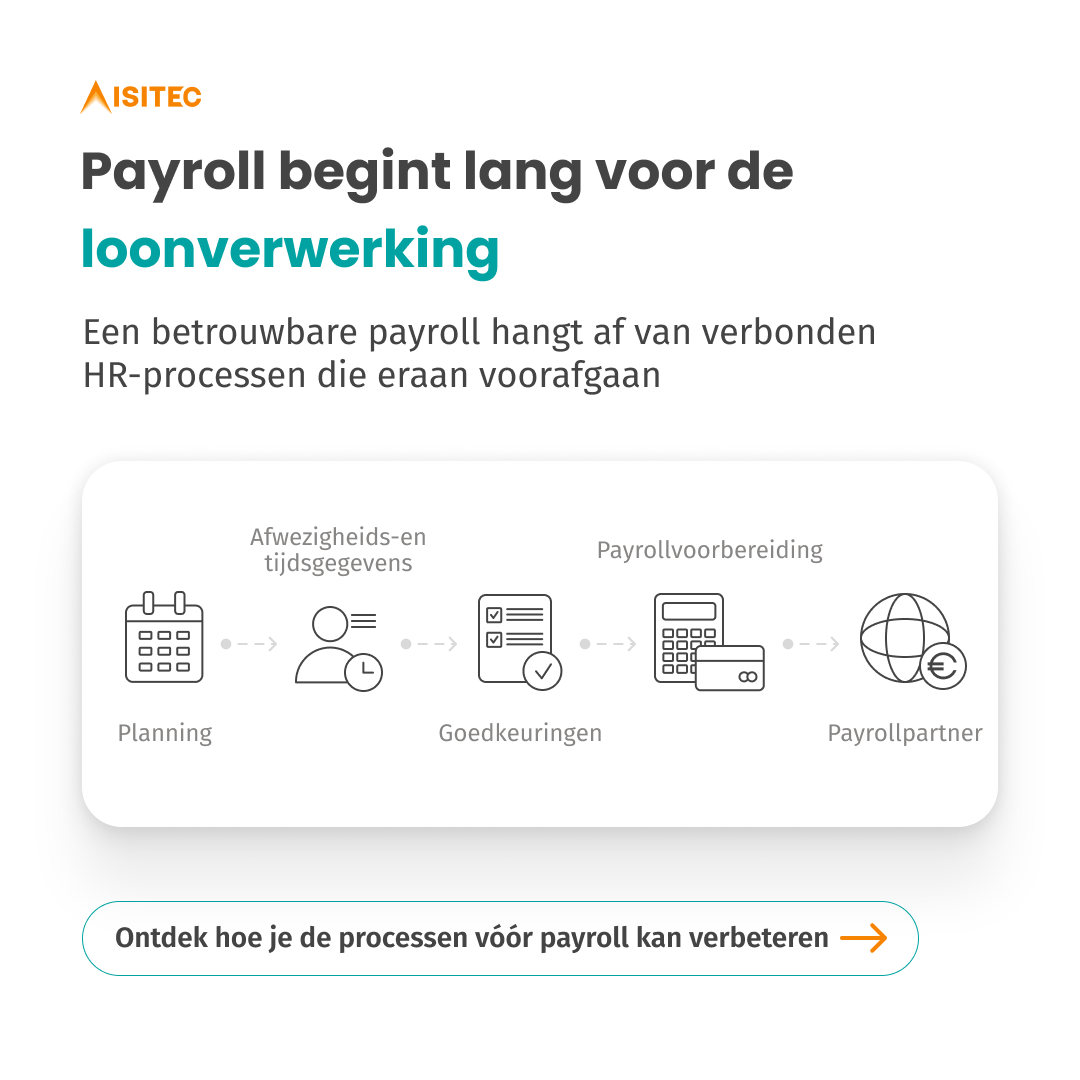
Before payroll processing can begin, worked hours, absences, premiums, contract changes and other employee data must be collected, checked and approved correctly. It is precisely within this process that much of the manual workload arises.
The payroll provider processes the information it receives.
The question is who ensures that this information moves through the organisation completely, correctly and on time beforehand.
Payroll begins long before the salary calculation
A salary calculation depends on decisions and registrations made throughout the entire month.
An employee takes leave. A shift changes. Someone works additional hours. A contract is adjusted. A premium must be awarded. An absence affects the schedule and, eventually, payroll processing.
When this data is spread across scheduling software, emails, spreadsheets, time-tracking systems and employee records, HR must bring it together at the end of the period.
This means checking whether the schedule matches the hours actually worked, confirming that absences have been registered correctly and verifying that all contract changes were processed on time.
The payroll provider ultimately receives one file or data flow.
But before that point, the organisation may already have completed a substantial amount of manual work.
Accurate payroll depends on accurate processes
When an error appears in payroll, the cause does not necessarily lie within the payroll calculation itself.
The error may have occurred earlier in the process.
A shift change was not communicated. An absence had not yet been registered correctly. A contract adjustment remained in someone’s inbox. A premium was tracked in a separate file and was not included in the final export.
Payroll can only be reliable when the information preceding it is reliable.
This means payroll is not an isolated administrative task, but the outcome of a complete HR workflow.
The more stages that are managed manually, the greater the risk that information is delayed, altered or lost along the way.
HR often remains the human integration layer
In many organisations, HR connects the different systems and stakeholders.
HR collects information from managers, compares schedules with registrations, follows up on missing approvals and checks whether data can be sent correctly to the payroll partner.
This work is rarely visible as a separate cost.
It is spread across recurring checks, emails, correction rounds and employee questions.
As long as the organisation remains relatively small, this approach may appear manageable. But as the number of employees, contract types, locations and exceptions grows, HR becomes increasingly occupied with managing data flows.
The payroll provider performs its role.
But HR makes sure the payroll provider has usable information to work with in the first place.
A payroll partner does not need to be a complete HR platform
The solution is not for payroll providers to suddenly take over every HR process.
Their strength lies precisely in payroll processing, local expertise and accurate administrative follow-up.
A specialised HR platform has a different role.
It manages the processes before payroll and ensures that information can flow through in a structured way.
This includes employee administration, time tracking, shifts, absences, contract workflows, approvals and payroll preparation.
The payroll provider remains responsible for salary processing.
The HR platform ensures that the right data is available at the right time.
This combination is often stronger than attempting to make one party responsible for the entire chain.
From separate data delivery to a connected workflow
In a connected HR workflow, changes are not only brought together at the end of the month.
They are registered where they occur and automatically follow the correct steps.
When a manager approves a change, it is added to the employee record.
When worked hours, premiums or absences affect payroll, they are converted into payroll-ready data.
When Finance needs insight, it does not have to wait for several files to be manually combined.
This does not only reduce the risk of errors.
It also gives HR greater control over the process without requiring the team to act as the connection between every system.
The role of Aisitec
Aisitec connects HR administration, scheduling, time tracking, contracts, approvals, absences and payroll preparation within one HR ecosystem.
The platform does not replace the payroll provider.
It ensures that the data required by the payroll provider is prepared in a structured and reliable way.
Aisitec can connect to existing payroll and ERP systems, meaning organisations are not required to replace their complete current environment.
The value lies in connecting daily HR processes with the eventual payroll operation.
This allows the payroll provider to continue focusing on its area of expertise, while HR spends less time collecting, checking and correcting information.
The real question begins before payroll
When evaluating payroll processes, companies often focus on the quality of the salary calculation.
That remains important.
But it is only one part of the complete process.
The broader question is:
How does all the information required for payroll move correctly through our organisation?
It is also worth asking:
- Where is data entered more than once?
- Which changes still need to be communicated manually?
- How many checks does HR perform because different systems do not communicate?
- Who manages the process between scheduling, contracts, absences and payroll?
A strong payroll provider ensures accurate salary processing.
A connected HR workflow ensures that payroll processing begins with complete and reliable information.
One does not replace the other.
They strengthen each other.
Connect the processes that come before payroll
Discover how Aisitec connects HR administration, scheduling, time tracking, contracts, absences and payroll preparation while allowing your payroll provider to remain focused on salary processing.
 English
 Dutch
 French