
For organisations with changing work schedules, workforce planning is essential.
Scheduling tools show who is working, when they are working, where they are assigned and which shifts still need to be filled. Particularly in sectors such as hospitality, healthcare and other environments with flexible teams, they provide considerable operational value.
But a schedule is never just a schedule.
Every change to a roster can affect worked hours, absences, contractual conditions, premiums, payroll and reporting.
A scheduling tool can adjust a shift.
The question is what happens to that information afterwards.
A roster is the beginning of a process
Imagine that an employee reports sick before an evening shift.
The planner finds a replacement and updates the roster. From an operational perspective, the problem appears to be resolved.
But that change raises several additional questions.
Has the absence been registered correctly? Will the replacement employee’s hours be processed accurately? Does an evening, night or weekend premium apply?
Does payroll need to be informed? Has the workforce cost been updated in the reporting?
When scheduling is disconnected from HR and payroll, all these consequences must be followed up separately.
The shift may be covered, but the complete process is not yet finished.
Scheduling tools show who is working, but not always what that means
A scheduling tool is generally designed to organise staffing.
That is valuable, but it does not automatically provide visibility into the complete employee context.
A planner may need to know which contract an employee has, how many hours have already been worked, which absences have been registered, whether the employee works across several locations and which rules apply to particular shifts.
When this information is stored in other systems, a gap develops between scheduling and the HR reality.
A manager may schedule someone, while HR later discovers that the change was not processed correctly from an administrative perspective.
Payroll may receive the worked hours but lack information about a premium or absence.
Finance may only see the actual workforce cost after several files have been combined.
The schedule functions, but the organisation continues to correct the consequences afterwards.
The complexity lies in what changes
A fixed roster is relatively straightforward to manage.
The real pressure arises when something deviates from the plan.
Employees become unavailable. Shifts are exchanged. Teams are distributed across several locations. Temporary employees join or leave. Overtime increases. A replacement changes again at the last minute.
In situations like these, speed matters.
But speed without connection can also create errors.
When a change is only processed within the scheduling system, other departments must rely on someone communicating the information later.
This leads to separate emails, spreadsheets and manual checks.
Not because the scheduling tool is failing to do its job, but because its responsibility ends with the roster.
What HR and payroll need
HR does not only look at who has been scheduled.
HR also needs to know:
- which contractual conditions apply;
- which absences have been registered;
- which changes still require approval;
- whether hours have been linked correctly to the employee record;
- what the consequences are for onboarding, leave or contract management.
Payroll, in turn, needs reliable data concerning worked hours, premiums, absences and other variable elements.
When this information does not arise automatically from the operational workflow, it must be collected and checked again at the end of the period.
That is where the time saved by the scheduling tool disappears again.
Reporting requires more than a staffing overview
A schedule provides insight into planned staffing levels.
Management and Finance usually need a broader view.
How do scheduled hours compare with hours actually worked?
Where is structural overtime developing?
Which teams or locations experience the greatest staffing pressure?
What is the impact of absences and replacements?
Which contracts or shifts generate additional costs?
To answer these questions, scheduling data must be connected to HR and payroll data.
Without that connection, reporting remains dependent on exports and manual interpretation.
From workforce scheduling to a connected workforce workflow
A connected workforce workflow does not treat a shift as an isolated piece of information.
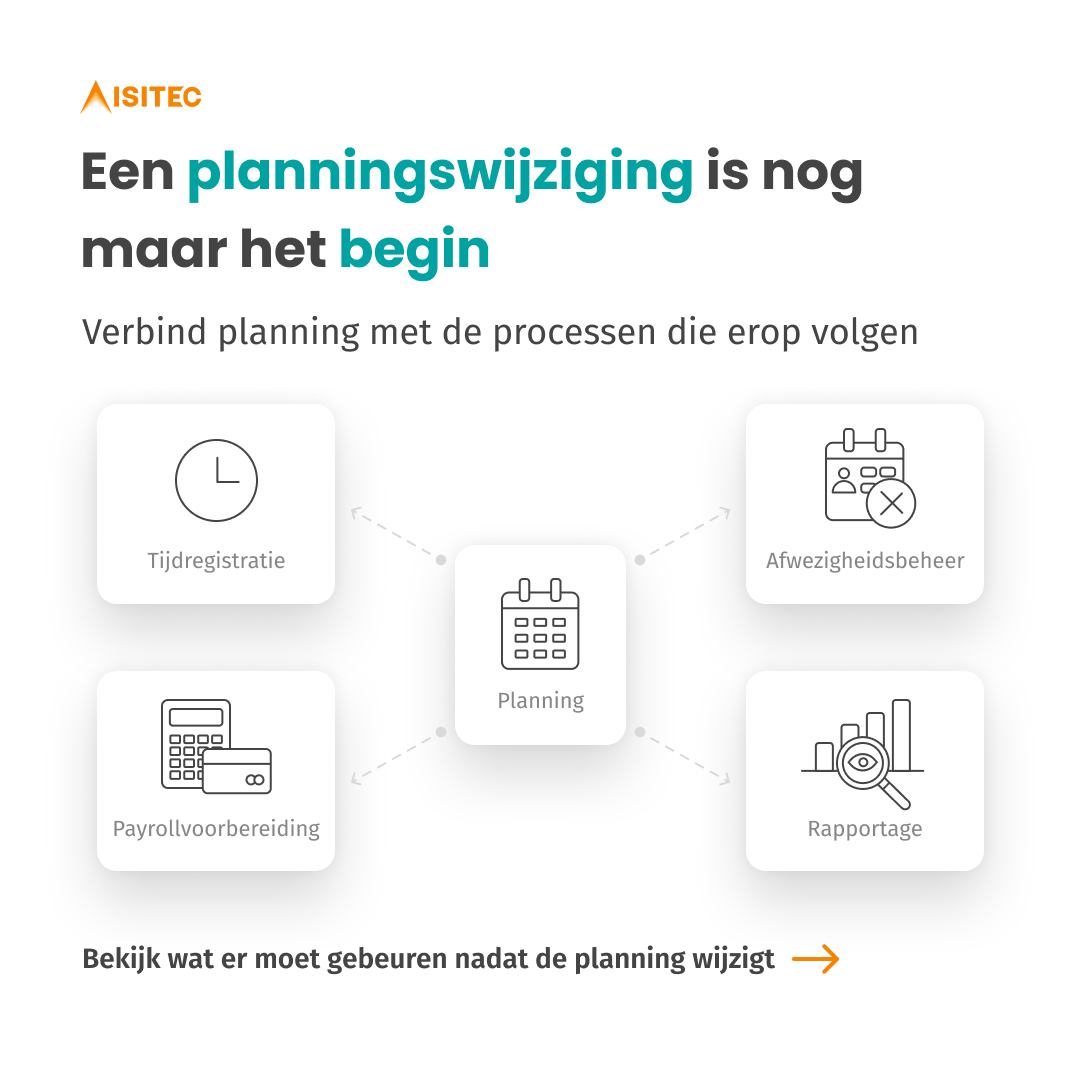
When a schedule changes, the relevant information flows through to the processes that follow.
Absences are registered correctly.
Worked hours and premiums are prepared for payroll.
Managers and HR work with the same data.
Finance and management gain access to reporting that does not first need to be assembled from several files.
This does not make scheduling less important.
On the contrary.
Scheduling becomes more valuable because it forms part of a more complete process.
The role of Aisitec
Aisitec connects workforce scheduling and time tracking with HR administration, absence management, contracts, approvals, payroll preparation and reporting.
As a result, a change to the roster does not remain limited to the scheduling process.
The relevant data can move through the complete HR workflow.
Aisitec can also connect with existing payroll, ERP and time-tracking systems. Organisations do not necessarily need to replace their entire current environment.
The difference lies in the connection between the processes.
A scheduling tool organises staffing.
Aisitec connects that staffing with the administrative, financial and management processes that depend on it.
The right question goes beyond the roster
When selecting workforce software, organisations rightly consider ease of use, flexibility and scheduling speed.
But one additional question is required:
What happens to the information after a shift has been scheduled or changed?
It is also worth asking:
- Does HR need to enter the data again?
- Does payroll need to wait for an export?
- Do managers need to communicate exceptions by email?
- Does Finance need to combine several sources afterwards?
When the answer to several of these questions is “yes”, the problem does not lie in the schedule itself.
It lies in the missing connection between scheduling and the rest of the organisation.
A good scheduling tool helps place the right people at the right time.
A connected HR ecosystem ensures that the rest of the process follows automatically.
Connect scheduling with the processes that follow
Discover how Aisitec connects workforce scheduling with time tracking, HR administration, absences, payroll preparation and reporting within one connected workflow.
 English
 Dutch
 French